


Airport layovers, more pleasure than pain
Airport layovers, more pleasure than pain
 (CNN) -- Airport layovers can be the most gruesome
leg of a journey. But airports are increasingly getting wise to the
needs of their passengers, offering a range of amenities from swimming
pools to yoga studios and even a golf course.
(CNN) -- Airport layovers can be the most gruesome
leg of a journey. But airports are increasingly getting wise to the
needs of their passengers, offering a range of amenities from swimming
pools to yoga studios and even a golf course. Last year, Dallas Fort
Worth International Airport decided it wanted to become "the healthiest
airport in the country, if not the world," according to spokeswoman
Cynthia Vega. They started by ensuring every one of their restaurants
had a low-fat, "healthy heart" option. Next, they introduced a 700-meter
walking path and opened a yoga studio free for passengers to use.
Last year, Dallas Fort
Worth International Airport decided it wanted to become "the healthiest
airport in the country, if not the world," according to spokeswoman
Cynthia Vega. They started by ensuring every one of their restaurants
had a low-fat, "healthy heart" option. Next, they introduced a 700-meter
walking path and opened a yoga studio free for passengers to use.
"You know what it's like
being trapped in the airport. You can only eat so much food or read so
many magazines," says Vega. "There is an inherent stress that goes along
with traveling. This is a good way to shake it off."
Increasingly, airports
are becoming more and more defined by their amenities. Hong Kong
International is known by many golfers for its nine-hole course,
visitors to Seoul can take a spin on the ice skating rink at Incheon
Airport, while travelers can take in an art exhibit or a classical piano
lesson while on layover in Amsterdam's Schiphol Airport.
 For those who travel constantly, airports are the new hometown.
Curtis Fentress
Arguably, Singapore's
Changi Airport spearheaded the trend back in the mid-1990s, when it
introduced a rooftop swimming pool and free internet terminals. In
recent years, Changi has continued to innovate, implementing a 24-hour
complimentary movie theater, free gaming rooms as well as foot massage
and napping stations. Two of their more off-beat recent additions
include the world's largest kinetic sculpture and an indoor slide.
"Passengers' demands have
changed considerably over the years," notes Ivan Tan, a spokesman for
Changi. "The airport is no longer an inconsequential stop along the way,
but a destination on its own."
Though the modern airport
is often compared to a shopping mall, Curtis Fentress, the architect
who designed Incheon Airport and is currently overseeing the $1.5
billion modernization of Los Angeles Airport, finds it would be more
accurate to view it as a mini city.
"While it's true there
is more shopping than ever in today's airports, there's also more
dining, more entertainment, and more culture," he says. "For those who
travel constantly, airports are the new hometown."
Delta Airlines have been
particularly keen to upgrade the airport experience at their terminals.
To date, they've invested $1.2 billion in their new terminal at New
York's JFK airport (set to open in May), and $160 million to spruce up
their LaGuardia presence.
You know what it's like being trapped in the airport. You can only eat so much food or read so many magazines
Cynthia Vega
Cynthia Vega
According to Gail
Grimmett, the senior vice president for Delta in New York, their aim is
to make traveling more comfortable, but also, to provide a taste of the
city beyond the airport walls. To accomplish this, Delta threw out all
the fast food outlets that are often de rigueur, and replaced them with
restaurants helmed by the New York City culinary elite, including alumni
from such notable city venues as Balthazar, Morimoto and the Brooklyn
Brewery.
"We wanted to provide a true New York experience," she explains.
The airline has also
been a leader in using technology to upgrade the passenger experience.
At both their LaGuardia and JFK terminals, Delta has introduced iPads at
departure gates and in a handful of restaurants. Passengers can use the
devices to read the paper, or order food and retail goods directly to
their seats.
"When you walk through
the airport, the whole vibe is different," notes Grimmett. "Even on days
when it's raining, or flights are delayed, there's such a sense of
serenity, because we've given people what they want while their waiting:
good food, a comfortable place to sit, and the ability to plug in and
do work." Grimmett notes that since adding these features, Delta's
customer satisfaction scores "have skyrocketed."
Of course, it was only a
matter of time before other airports followed suit. Dallas Fort Worth
was one of the first airports to create a mobile app that can help users
find a parking space, check out the nearest concessions, and use GPS to
map the closest stores and food outlets.
"We're a really user-friendly airport, which is a challenge, given we're huge; we're the size of Manhattan," says Vega.
 The upgraded experience
is just as beneficial for the airports, whose income is increasingly
made up of cash pulled in from retail, food and any other source not
directly related to flight. Fentress figures that within a few years,
"the majority of airport revenue will be non-aeronautical."
The upgraded experience
is just as beneficial for the airports, whose income is increasingly
made up of cash pulled in from retail, food and any other source not
directly related to flight. Fentress figures that within a few years,
"the majority of airport revenue will be non-aeronautical."
Tell us what your favorite airport are, and why, in the comments, below.
Activists: Get rid of 'degrading' parts of India's sexual assault exam
Activists: Get rid of 'degrading' parts of India's sexual assault exam
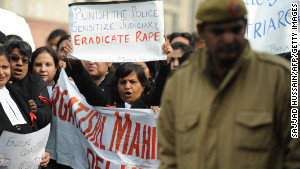 (CNN) -- With a glaring spotlight on sexual violence after a fatal gang-rape case,
a high-profile government panel has joined women's rights advocates in
demanding changes to India's sexual assault medical exam.
(CNN) -- With a glaring spotlight on sexual violence after a fatal gang-rape case,
a high-profile government panel has joined women's rights advocates in
demanding changes to India's sexual assault medical exam.
Advocates say the exam includes unnecessarily invasive and irrelevant procedures.
The exam can include
detailed observation of the victim's hymen, the description of her
nourishment level and body, and a so-called "two finger" test.
The finger exam consists
of the doctor inserting two fingers into the woman's body to determine
whether she is used to sexual intercourse. The underlying assumption is
that if two fingers pass, the woman is used to sexual intercourse.
"Are you trying to say
married women can't get raped? That only virgins get raped?" asked Donna
Fernandes, of Vimochana, a women's organization in Bangalore. "That she
couldn't have been raped, because she was used to sexual intercourse?
It's an unscientific way to approaching whether the rape has happened or
not."
Advocates like Fernandes
who have called for reform in the medical exam have received critical
backing from a panel appointed by India's home affairs minister.
Last week, the commission
published a 600-page report calling for several policy changes, such as
creating a new offense of gang rape punishable by at least 20 years in
prison, making it a crime for police to fail to investigate sexual
assault complaints and banning the consideration of character or
previous sexual experience of the victim at a criminal trial.
The panel report came
after the outrage over the gang rape and subsequent death of a
23-year-old physiotherapy student, which prompted calls for reform on
how rape is addressed by India's police, courts and government. It has
prompted initial changes -- such as increasing the number of women
working in New Delhi police stations and official pledges to strengthen
laws regarding rape and assault.
The five suspects accused of taking part
in the December 16 gang rape of a woman in New Delhi, are being tried
in a "fast-track" court designed to bypass red tape. The sixth suspect
in the gang rape is a minor and will be tried in juvenile court, according to police.
The government-appointed
panel, headed by India's former chief justice, J.S. Verma, devoted a
chapter of its report to medical exams, criticizing controversial
aspects that delve into a woman's sexual history such as the finger test
and the hymen observation.
"A test to ascertain the
laxity of the vaginal muscles which is commonly referred to as the
two-finger test must not be conducted," the report stated. It also added
that the "observations/conclusions such as 'habituated to sexual
intercourse' should not be made and this is forbidden by law."
The two finger test "has
nothing to do with the rape case," said Dr. Jagadeesh Reddy, professor
of forensic medicine at Vydehi Medical College in Bangalore. "After a
sexual assault, doing a two-finger test is not scientific."
The finger test is not
an accurate test of sexual activity, as doctors have different sized
fingers and in some cases, report opposite findings on the same patient,
he said.
In obstetrics, the
two-finger exam is used to check the progress of labor. But in the
context of a sexual assault exam, it is used to indicate a woman's
sexual history, which has enraged activists.
The report also
denounced the hymen observation calling it, "largely irrelevant" and
recommended that "only those that are relevant to the episode of assault
are to be documented."
The hymen test has also
been used to infer whether a woman was used to sexual intercourse,
despite the fact that some females are born without the tissue and it
can be torn for various reasons besides sexual intercourse.
The findings on whether a
woman was used to sexual activity would be used to "perpetuate false
and damaging stereotypes of rape survivors as 'loose' women," according
to a Human Rights Watch report
on India's forensic exams of rape survivors published in 2010. "Defense
attorneys use the findings to challenge the credibility, character, and
the lack of consent of the survivors," the report said.
The group has called the worst cases of medical exams "degrading and counter-productive."
Activists in Bangladesh
are also calling for the two-finger test to be banned there. More than
100 experts including doctors, lawyers, police, women's rights activists
signed a joint statement this month arguing that the "demeaning" test "does not provide any evidence that is relevant to proving the offence."
Meanwhile, reported rape cases in India -- where a cultural stigma keeps many victims from reporting the crime -- have increased drastically over the past four decades, from 2,487 in 1971 to 24,206 in 2011, according to official figures.
Padma Deosthali,
coordinator of the Centre for Enquiry into Health and Allied Themes in
Mumbai has long advocated for reforms in the way sexual assault cases
are handled.
"The Verma commission
has made some significant recommendations in its report," she said. "The
report recognizes sexual assault as a medicolegal emergency and makes
it obligatory for all doctors (public and private sector) to care for
survivors immediately without waiting for any police complaint. The
challenge now is to translate this into law and health policies."
The report remains a set of recommendations, unless the Indian Parliament takes action to vote them into law.
One major turning point of the report is that it calls for the mental and physical support of the patient, she said.
Survivors of sexual
assault often get little to no care for the possibility of pregnancy,
sexually transmitted infections and psychological distress, Deosthali
said. This is lacking across Indian states, in both rural and urban
areas, she added.
The panel declared that
hospitals are "required to preserve the life of the victim and for her
recovery." It recommended that the victim first see a professional
counselor, followed by a doctor and the police.
Defense attorneys use the findings to challenge the credibility, character, and the lack of consent of the survivors
Human Rights Watch report
Human Rights Watch report
"It says that treatment
has to be over and above everything. It ropes in the private sector, in
terms of making them accountable, and telling them it is their
obligation to provide treatment," Deosthali said.
In cases of sexual assault, some doctors refuse to treat patients. The report proposes making this a punishable offense.
"In our opinion, the
duty of the medical profession to extend unqualified services to victims
of such heinous offenses should be duly publicized and medical
professionals and hospitals who abstain from performing the same ought
to be punished in accordance with law," the commission stated.
Challenges remain with the sexual assault exam that weren't mentioned in the report, though, Deosthali said.
During medical exams,
doctors take note of the physical build and nourishment of the woman.
Even among medical professionals, there are notions that a healthy woman
would have been able to fight back her attackers, said Reddy, who has
conducted sexual assault medical exams.
The notion is perpetuated in forensic medical textbooks, Deosthali said.
If a sexual assault
survivor lacks obvious signs of injury, this may bias the case, because
there is such an emphasis on finding injuries during the exam, Reddy
said.
"It's not necessary to have injuries in sexual assault," he said. "The absence of injury doesn't mean she has consented."
Rape cases can lack
obvious signs of harm, because the victim could have been unconscious,
intoxicated or the assailant could have used lubrication.
The government-appointed
panel warned against relying heavily on "the marks of struggle." It
cited a law commission that said: "The Indian law of evidence does not,
in general, lay down that a particular species of evidence should be
insisted upon any proof or disproof of a particular fact."
Unit Map: How Did I Become the Person I Am?
Unit Map: How Did I Become the Person I Am?

Introduction
This unit has been designed for grades 6-8. The recommended timeframe is 1-2 weeks.
Our curriculum frameworks are created by Dr. Heidi Hayes Jacobs and her Curriculum 21 faculty.
Our curriculum frameworks are created by Dr. Heidi Hayes Jacobs and her Curriculum 21 faculty.
Big Ideas / Enduring Understandings
- Our past as humans foreshadows who we will become.
- Migration of humans affects their chances for survival.
- Over time, migrations of a species lead to permanent changes/mutations in the species and their cultures.
- The history of a people’s culture impacts change.
Essential Questions
- How can our past determine who we, as humans, become?
- In what ways can migration of a species affect the chance for survival?
- How have migrations of humans led to permanent change in the human race?
- How can the history of a species prevent change?
Common Core Standards
- Reading Standards for Literacy in History/Social Studies
Grade 6-8 Students
Key Ideas and Details
1. Cite specific textual evidence to support analysis of primary and secondary sources.
2. Determine the central ideas or information of a primary or secondary source; provide an accurate summary of the source distinct from prior knowledge or opinions.
3. Identify key steps in a text’s description of a process related to history/social studies (e.g., how a bill becomes law, how interest rates are raised or lowered).
Craft and Structure
6. Identify aspects of a text that reveal an author’s point of view or purpose (e.g., loaded language, inclusion or avoidance of particular facts).
Integration of Knowledge and Ideas
7. Integrate visual information (e.g., in charts, graphs, photographs, videos, or maps) with other information in print and digital texts.
8. Distinguish among fact, opinion, and reasoned judgment in a text.
9. Analyze the relationship between a primary and secondary source on the same topic.
- Writing Standards for Literacy in History/Social Studies
Grade 6-8 Students
Text Types and Purposes
1. Write arguments focused on discipline-specific content.
a. Introduce claim(s) about a topic or issue, acknowledge and distinguish the claim(s) from alternate or opposing claims, and organize the reasons and evidence logically.
b. Support claim(s) with logical reasoning and relevant, accurate data and evidence that demonstrate an understanding of the topic or text, using credible sources.
e. Provide a concluding statement or section that follows from and supports the argument presented.
2. Write informative/explanatory texts, including the narration of historical events, scientific procedures/ experiments, or technical processes.
a. Introduce a topic clearly, previewing what is to follow; organize ideas, concepts, and information into broader categories as appropriate to achieving purpose; include formatting (e.g., headings), graphics (e.g., charts, tables), and multimedia when useful to aiding comprehension.
b. Develop the topic with relevant, well-chosen facts, definitions, concrete details, quotations, or other information and examples.
c. Use appropriate and varied transitions to create cohesion and clarify the relationships among ideas and concepts.
d. Use precise language and domain-specific vocabulary to inform about or explain the topic.
e. Provide a concluding statement or section that follows from and supports the information or explanation presented.
Production and Distribution of Writing
4. Produce clear and coherent writing in which the development, organization, and style are appropriate to task, purpose, and audience.
5. With some guidance and support from peers and adults, develop and strengthen writing as needed by planning, revising, editing, rewriting, or trying a new approach, focusing on how well purpose and audience have been addressed.
6. Use technology, including the Internet, to produce and publish writing and present the relationships between information and ideas clearly and efficiently.
Research to Build and Present Knowledge
8. Gather relevant information from multiple print and digital sources, using search terms effectively; assess the credibility and accuracy of each source; and quote or paraphrase the data and conclusions others while avoiding plagiarism and following a standard format for citation.
- NETS Standards
Creativity and Innovation
1. Students demonstrate creative thinking, construct knowledge, and develop innovative products and processes using technology.
a. Apply existing knowledge to generate new ideas, products, or processes.
b. Create original works as a means of personal or group expression.
c. Identify trends and forecast possibilities.
Communication and Collaboration
2. Students use digital media and environments to communicate and work collaboratively, including at a distance, to support individual learning and contribute to the learning of others.
a. Interact, collaborate, and publish with peers, experts, or others employing a variety of media and formats.
b. Communicate information and ideas effectively to multiple audiences using a variety of media and formats.
d. Contribute to project teams to produce original works or solve problems.
Research and Information Fluency
3. Students apply digital tools to gather, evaluate, and use information.
a. Plan strategies to guide inquiry.
b. Locate, organize, analyze, evaluate, synthesize, and ethically use information from a variety of sources and media.
c. Evaluate and select information sources and digital tools based on the appropriateness to specific tasks.
d. Process data and report results.
Critical Thinking, Problem Solving, and Decision Making
4. Students use critical thinking skills to plan and conduct research, manage projects, solve problems, and make informed decisions using appropriate digital tolls and resources.
a. Identify and define authentic problems and significant questions for investigation.
b. Plan and manage activities to develop a solution or complete a project.
c. Collect and analyze data to identify solutions and/or make informed decisions.
Digital Citizenship
5. Students understand human, cultural, and societal issues related to technology and practice legal and ethical behavior.
b. Exhibit a positive attitude toward using technology that supports collaboration, learning, and productivity.
d. Exhibit leadership for digital citizenship.
Technology Operations and Concepts
6. Students demonstrate a sound understanding of technology concepts, systems, and operations.
b. Select and use applications effectively and productively.
d. Transfer current knowledge to learning of new technologies.
Content
- A. Geography (Longitude, Latitude, 23rd Parallel, Map Skills)
- B. Research
- C. Common Human Origins
- D. Human Migration and Development
(Causes, Effects, Connections to Current Migration and Development of
Humans, Political Unrest)
- E. Religion
- F. Environmental Changes (Causes, Effects, Natural Resources, Urbanization, Connections to Current Environmental Changes)
- G. Political Influences on Human Migration and Development (Causes, Effects, Outcomes)
Skills / Strategies
- A. Explain how longitude and latitude are essential in a trek similar to Paul Salopek’s.
- A. Analyze the significance of the 23rd Parallel to human origins and migration.
- A. Map migration and settlement conflicts.
- B. Compare and contrast primary and secondary sources of information about historical migrations of humans.
- C. Identify varying accounts of human origins.
- D. Compare and contrast the varying accounts of human origins.
- D. List and explain the causes of human migration and development.
- D. Identify and explain the effects of human migration and development.
- D. Make connections among historical human migrations and the current migrations and continued human development.
- E. Explain how religion relates to human migration.
- F. Summarize the causes of environmental change.
- F. List and explain the effects of environmental changes.
- F. Analyze the way in which natural resources have influenced environmental changes.
- F. Explain how urbanization has influenced environmental changes.
- F. Make connections among historical climate changes and the current climate changes that are occurring.
- G. Explain how politics throughout history have caused mass human migrations.
- G. Determine how political unrest affects human migration and development.
- F. Summary of discussions on blogs and explanation of possible solutions to the problem of massive migration of humans.
- G. Debate and evaluation of arguments on
both sides of the statement, “Migration of humans from the beginning of
their time on Earth to modern day has had a profound effect on the
Earth, its resources and people." The rubric created by students and
teacher.
- H. Backchannel log as a review and assessment tool to check for student understanding of the points made during the debate.
- I. Final Assessment: Written, digital,
or photographic policy brief in which the students discuss the ethics,
problems, and solutions of human migration, which is housed on a class
wiki and could be shared at a symposium on migration.
- J. Google Maps gives insight to students’
understanding of relationship between geographic location and global
issues, historic and modern events or Paul Salopek’s experiences and
current news.
- K. Visual dictionary entries and quality of the entries.
Key terms / Vocabulary
- Pilgrimage
- Migration
- Extinction
- Urbanization
- Natural Science
- Mutations
- Nomads
- Longitude
- Latitude
- 23rd Parallel
Learning Plan & Activities
- A. Conduct group discussions outlining
the successes and obstacles that Paul Salopek might experience on this
trek to trace the origin and development of human beings. Use a
collaborative tool such as Type With Me to collect thoughts and opinions and analyze data. Share this information with the class orally or on a class wiki.
- B. Use World Mapper
or another such site to collect data on historical world-wide
migration. Present the data using charts and graphs. Use this data for
the written work listed later.
- C. Use a site such as Glogster
to create multimedia posters online outlining the path Paul Salopek is
walking, adding text, movies, audio and images to visualize the
problems or issues he is encountering along the way. Students link
individual glogs to others that share a connection or have a deeper
explanation of a particular topic/issue.
- D. Use the charts, graphs and data created, in addition to the group discussion data, to create an Infographic on Pikto Chart or another service. Share created infographic on the class wiki, blog or website.
- E. Interview of individuals who have
migrated to the United States. Prepare a list of questions for the
interview that explore the interviewee’s reasons for leaving his/her
home country, the obstacles that he/she encountered along the journey to
the United States, the benefits from the journey and the settlement in
the final destination in the United States, and any changes that modern
migrants might experience in themselves. The students should not only
collect information from the interviews, but also they should storyboard
their information, and present the information to the class to
demonstrate their media editing skills. Use Digital Storytelling wiki
to share the interview and information on a class or school wiki. In
addition to a written interview summary, students can record the
interview as an audio or video file and edit with
Audacity(PC)/Garageband (mac/iPad) or Windows Movie Maker (PC) /iMovie
(mac/iPad). These podcast (audio) or vidcast (video) files can be
embedded on the same wiki.
- F. Create a blog about human origins and
migrations of humans around the world that can be maintained by the
discussion groups to obtain information and opinions from students
around the world. This should be a collaborative blog with the various
discussion groups posting on different topics or points of view. One RSS
feed will allow the reader to have everything under one URL address,
but blog can be filtered according to categories or authors.
- G. Debate: Both Sides of the Statement:
“Migration of humans from the beginning of their time on Earth to modern
day has had a profound effect on the Earth, its resources and people.”
Collaboratively, the students and teacher should create a rubric with
criteria and descriptors for evaluating the debates.
- H. Use a backchannel (private chatroom), such as Today's Meet
to allow students to collaboratively take live notes of the debate, add
questions that the moderator of the debate might use to ask further
questions. Students have the ability to use the backchannel log to later
review and harvest important points made or information shared.
- I. Use Google Docs
to have students write collaboratively, peer edit, leave comments and
suggestions for each other and aid in the editing process. Shift from
“turning in writing process samples to “sharing” writing in order to
make the writing process transparent and improve editing opportunities.
- I. Mine the Pulitzer Center website
for opportunities that exist for student journalists to submit written,
digital, and photographic essays addressing the problem of mass
migrations of humans. Use data to support the opinion expressed in the
essay that you will be submitting.
- I. Submit the essays to the Pulitzer Center competition as groups or individuals.
- J. Create a collaborative, annotated digital map at Google Maps.
This could be created among students of your class or collaborating
with another class following Paul Salopek’s journey. Add different
placemarks to locations of the walk. Students need to choose a title for
each placemark and add a short summary of events taking place during
Paul’s walk.
- K. As the Walk out of Eden progresses,
students create a visual dictionary of vocabulary words they are
studying, are unfamiliar with or consider important to the context of
the journey. They can use presentation software, such as PowerPoint
(PC), Keynote (mac/iPad app) or PicCollage (iPad app) to create these
visual dictionaries. Students will continue adding words, definitions
and visuals as the walk progresses.
Assessments
- A. Collection of group discussion data on human migration and development.
- B. Charts, graphs, and data created on World Mapper or another such website to indicate migration of the earth’s people in modern times.
- B. Summary of data collected on migration trends and conclusions shared on a class wiki.
- C. Multimedia posters that indicate the
path of the walk “Out of Eden” to show students’ skills in media
literacy and the connection between content and media.
- D. Infographic demonstrating
understanding and correlation between charts, graphs and data generated
and collected in previous assessments or activities
- E. Digital Storytelling: Data with the list of questions for the interview and the spontaneous follow-up questions.
- E. Digital Storytelling: Audio or video media presentation of the interviews and information collected.
B&C: News of the World phone-hacking scandal
News of the World phone-hacking scandal
The row over
phone-hacking by journalists has led to the closure of the News of the
World newspaper, the establishment of the Leveson Inquiry, an MPs'
inquiry and the launch of three police investigations.
The BBC takes a look at the key questions it poses.
What is the phone-hacking scandal?
The story goes back to 2006-07 when Clive Goodman, the then News of the World royal editor, and Glenn Mulcaire, a private investigator were convicted of intercepting voicemail messages left for royal aides and subsequently jailed.
Their newspaper said they had acted alone - but the then editor Andy Coulson quit, saying he took responsibility for what happened.
Two years later, the Guardian newspaper reported that News International had made confidential settlements totalling £1m to three people who said their phones had been hacked. By September 2010 a string of well-known people began legal moves to have their claims looked at again amid mounting suspicions that phone hacking had been more widely used.
The turning point came in January 2011 when the Metropolitan Police launched Operation Weeting, a fresh phone hacking investigation which included looking at the original 2006 case. The investigation slowly widened to include allegations of improper payments to public officials and separate claims of computer hacking.
The critical political moment in the affair came when the Guardian newspaper reported that the newspaper had hacked the mobile phone belonging to murdered schoolgirl Milly Dowler.
What happened to the News of the World?
The
Sunday newspaper was one of the oldest in the UK and sold some 2.8m
copies every week. Its fondness for sex scandals gained it the nickname
"News of the Screws". Rupert Murdoch closed it down in the wake of the Milly Dowler revelations. Its final front page declared "Thank you and goodbye".
 Claims that Milly Dowler's phone was hacked were described as "truly dreadful" by the prime minister
How many people have been hacked?
More
than 4,000 people have been identified by police as possible victims of
phone hacking by the NoW. The forthcoming prosecutions (see below)
specify 600 identifiable alleged victims. The alleged targets have included politicians, celebrities, actors, sports people, relatives of dead UK soldiers and people who were caught up in the 7/7 London bombings.
How does phone hacking work?
The
opportunity to access voicemail messages came down to a simple security
oversight. Mobile phones used to be supplied with a default factory-set
personal identification number that could be used to access voicemail
from another phone or abroad. Customers were encouraged to change that
Pin, but very few did. That meant that anyone could call the phone and if the owner did not answer, the caller could use the Pin to access the voicemail and any stored messages.
Is phone hacking illegal?
Yes. Hacking voicemails is classed as an unlawful interception of communications under Section One of the Regulation of Investigatory Powers Act 2000.
Has anyone been charged?
On 24 July, the Crown Prosecution Service announced it would be charging eight people with
phone hacking. The group includes Andy Coulson, the former News of the
World editor and, more recently, David Cameron's former spokesman.
Rebekah Brooks, the former chief executive of News International, was
also among those charged. Both Ms Brooks and Mr Coulson have said they
will fight to clear their names. Rebekah Brooks, her husband and others
also face a separate charge of conspiracy to pervert the course of
justice in relation to the police investigations.
What role has the Met Police played in the affair?
 Sir Paul Stephenson quit as Met chief amid criticism for hiring an ex-NoW executive as an advisor
The original inquiry in 2006 resulted in just two arrests. Officers told MPs on the Home Affairs Select Committee that News International had tried to "thwart" the original inquiry.
In 2009 the force decided not to relaunch the investigation despite pressure to do so. Since then, the force has faced claims of an overly cosy relationship with News of the World journalists. Sir Paul Stephenson quit as the Met's commissioner, as did assistant commissioner John Yates, following criticism of police links to former News of the World deputy editor Neil Wallis.
In February 2012, the force also formally accepted it had failed to warn some people they could have been victims of hacking by the NoW.
What has happened to victims?
News
Corporation set up a special process to consider compensation claims
for those who believe they were hacked. Some cases have already been
settled in the High Court. These include a payment of £600,000 to singer
Charlotte Church and her parents. You can read about more victims here.
How has the government handled the affair?
The prime minister has announced two inquiries and said the Press Complaints Commission should be scrapped.Lord Justice Leveson is conducting a two-part inquiry, initially looking at "the culture, practices and ethics" of the UK press and its relationships with police and politicians. It will later examine the extent of unlawful conduct within newspaper groups and the police's original phone-hacking investigation.
 Andy Coulson blamed coverage of the phone-hacking story for his resignation
She concluded that the "close relationship" between parts of Scotland Yard and the media had caused "serious harm". She said there were "some very serious issues" relating to contact between journalists and police which had "eroded trust from the public". Among her recommendations, she told officers to "watch out" for "late-night carousing" with journalists, and flirting.
Prime Minister David Cameron has faced questions over his judgement, given that he employed Mr Coulson.
How has News International responded to the scandal?
News Corp boss Rupert Murdoch has issued an apology for the "serious wrongdoing" by the NoW. In July 2011, Rupert Murdoch and James Murdoch gave evidence to the House of Commons Culture, Media and Sport Select Committee and denied knowing the full extent of the allegations until evidence in civil cases was requested in late 2010.
James Murdoch told MPs he had not been aware of an email suggesting hacking went beyond a single "rogue" reporter. Two former News of the World executives later issued a statement claiming they had informed him.
James Murdoch was questioned again by the media committee in November 2011 and reiterated his claim that he had been unaware of the scale of phone hacking.
Langganan:
Postingan (Atom)